
Top.Mail.Ru

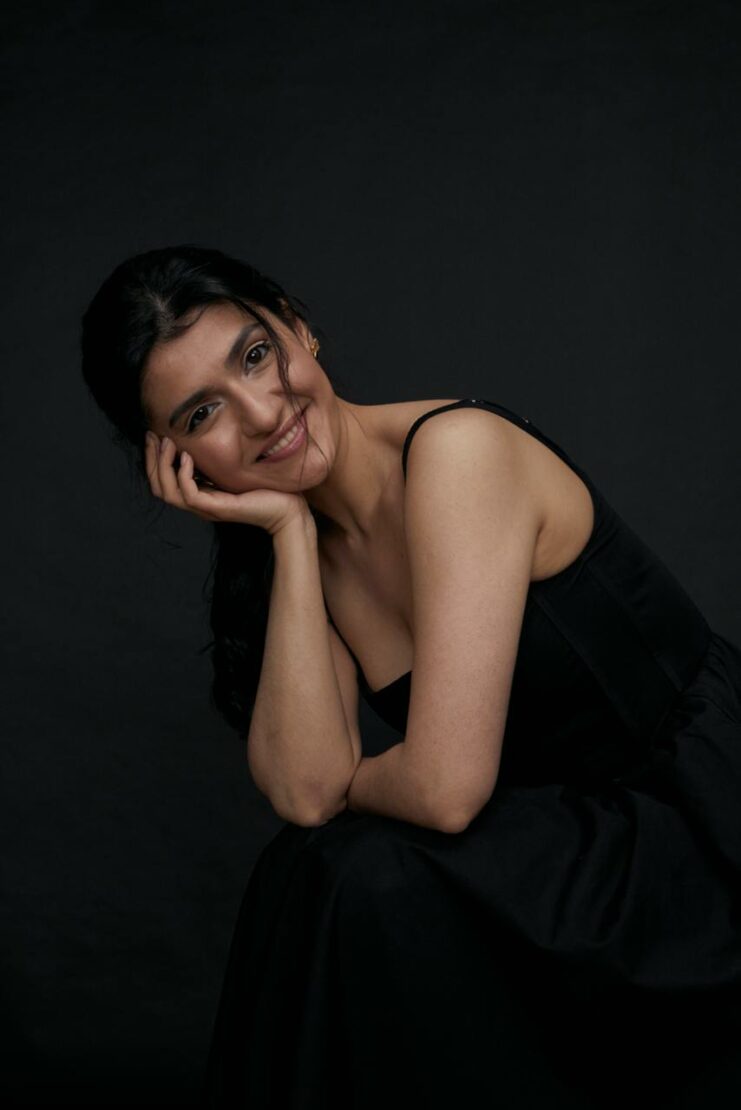
Iveta Simonyan

Soprano

Born in Novosibirsk, Iveta Simonyan graduated from the Rimsky-Korsakov St Petersburg State Conservatory where she studied in the class of Professor Olga Kondina. She has refined her skills in master classes with renowned musicians, including Teodor Currentzis, Jennifer Larmore, Dmitry Vdovin, and Tamara Novichenko.

She is a laureate and prize winner of numerous vocal competitions. Notable awards include the diploma at the New Opera World International Opera Competition (Moscow, 2020), the special prize of the Chairman of the jury at the Opera Bella Competition (Moscow, 2021), the Second Prize at the Leonid Sobinov Vocal Competition within the Leonid Sobinov Music Festival (Saratov, 2022), and the award at the All-Russian Vocalists Competition (St. Petersburg, 2024).

Iveta Simonyan made her professional debut in 2023 as the Queen of the Night in Mozart’s The Magic Flute on the stage of the St Petersburg Music Hall Theatre. From 2023 to 2025, she was a soloist of the Primorsky Stage of the Mariinsky Theatre and took part in the First Far Eastern Easter Festival. Her repertoire at that stage included the parts of the Queen of the Night (Mozart’s The Magic Flute), Gilda (Verdi’s Rigoletto), Voices from Heaven (Verdi’s Don Carlos), Frasquita (Bizet’s Carmen), Norina (Donizetti’s Don Pasquale), Marfa (Rimsky-Korsakov’s The Tsar’s Bride), Ninetta (Prokofiev’s The Love for Three Oranges), and Brigitte (Tchaikovsky’s Iolanta).

In the 2025/26 season, Iveta Simonyan became an artist-mentee at the Anton Rubinstein Academy. At the Academy, she made her debut in the Händel. A Dedication Ceremony project, presented in St Petersburg (Dom Radio), Moscow (Zaryadye Concert Hall), Thessaloniki, Madrid (Auditorio Nacional de Música), Valencia (Palacio de la Música) and Barcelona (Palau de la Música Catalana).

In September 2026, she made her debut on the stage of the Moscow Novaya Opera Theatre in the title role of Pascal Dusapin’s Passion with the musicAeterna Orchestra and Choir conducted by Teodor Currentzis.

WHAT BROUGHT YOU TO THE WORLD OF MUSIC?
I've been studying music since the age of three. At first, I only did the violin, but one day my mother took me to my brother's piano lesson. And while he was studying, I hummed the pieces he was playing. The teacher mentioned that maybe I should take up singing, and that is how I got my second speciality. When I graduated from music school, I decided to apply for academic vocals at a musical college. 'Singing is easy and so enjoyable! I'll pick what is easier,’ I thought. In fact, I am very grateful to my teachers for this 'easy' learning. My voice type was immediately identified correctly, I have never experienced difficulties. I was very lucky in this.
WHY ARE YOU INTERESTED IN WORKING AT MUSICAETERNA?
I like the repertoire that I sing in musicAeterna. Here I can apply skills that are not in demand in most theatres. For example, at musicAeterna, I had the opportunity to work on Baroque music, and it is in this direction that I want to develop. Maybe playing the violin pushed me to do this. I feel more like a musical instrument, I'm interested in interacting with other participants in the process, being part of a larger whole. musicAeterna is a field where you can grow, a difficult path, but the right one for me. There is a sense of lively creative work here.
WHAT IS YOUR FAVOURITE MUSIC?
Brahms comes to mind first. There is sensuality in his music, but at the same time it appeals to your higher self. Brahms is such an intellectual passion, intellectual Romanticism.

In my youth, I used to sing in an Armenian church for several years. It was a very valuable experience. Armenian spiritual chants — sharakans — are quite difficult from the point of view of technique, they have many tessitural difficulties. Such a sound is an element of national identity, a feature that is important to preserve and cultivate. I really miss it now. And in church, I could sing for hours on end and not get tired — I still haven't figured out why. I enjoyed the realisation that my voice could be heard, but no one could see me. I think when people don't watch a performance, but just listen to music, for example, with their eyes closed, its effect is much more powerful.
HOW DO YOU FEEL WHEN YOU GO ON STAGE?
On stage, we become vulnerable, but in a good way. This is the moment when you can be truly honest. When I see the eyes of the people in the audience, I remember why I make music. I always get a lot of support from the audience.
WHAT INSPIRES YOU?
Extensive perceptive experience is very important for inspiration — in visual arts, music, and literature, it shapes taste. It also seems to me that inspiration is not always bright, sometimes you need to plunge into darkness to find new colours. I think life in all its diversity, observing it, is an inexhaustible source of inspiration. Because in fact, art and music are all about us.

Events

+

György Kurtág (b. 1926)
Songs of Despair and Sorrow for mixed choir with instrumental accompaniment, Op. 18 (1980–1994)

So weary, so wretched to the words of Mikhail Lermontov (1840)
Night, an empty street, a lamp, a drug-store to the words of Alexander Blok (1912)
Blue Evening to the words of Sergei Yesenin (1925)
Where can I go to in this January? to the words of Osip Mandelstam (1937)
The Crucifixion to the words of Anna Akhmatova (1939)
It’s time to the words of Marina Tsvetaeva (1941)

Grabstein für Stephan | Gravestone for Stephan for guitar and instrumental ensemble, Op. 15c
(1989)

Johannes Brahms (1833–1897)
Ein deutsches Requiem | A German Requiem for soprano, baritone, choir and orchestra, Op. 45 (1865–1869)

Selig sind, die da Leid tragen | Blessed are those who weep, for they will be comforted
Denn alles Fleisch, es ist wie Gras | For all flesh is like grass
Herr, lehre doch mich, dass ein Ende mit mir haben muss | Lord, teach me that I must have an end
Wie lieblich sind Deine Wohnungen, Herr Zebaoth! | How lovely is Thy dwelling place, O Lord of hosts!
Ihr habt nun Traurigkeit | Ye now therefore have sorrow
Denn wir haben hier keine bleibende Statt | For here we have no continuing city
Selig sind die Toten, die in dem Herrn sterben | Blessed are the dead who die in the Lord

The programme is subject to change.

Performers:

Iveta Simonyan — soprano
Vladislav Chizhov — baritone

The musicAeterna Choir and Orchestra
Conductor — Teodor Currentzis 


+

György Kurtág (b. 1926)
Songs of Despair and Sorrow for mixed choir with instrumental accompaniment, Op. 18 (1980–1994)

So weary, so wretched to the words of Mikhail Lermontov (1840)
Night, an empty street, a lamp, a drug-store to the words of Alexander Blok (1912)
Blue Evening to the words of Sergei Yesenin (1925)
Where can I go to in this January? to the words of Osip Mandelstam (1937)
The Crucifixion to the words of Anna Akhmatova (1939)
It’s time to the words of Marina Tsvetaeva (1941)

Grabstein für Stephan | Gravestone for Stephan for guitar and instrumental ensemble, Op. 15c
(1989)

Johannes Brahms (1833–1897)
Ein deutsches Requiem | A German Requiem for soprano, baritone, choir and orchestra, Op. 45 (1865–1869)

Selig sind, die da Leid tragen | Blessed are those who weep, for they will be comforted
Denn alles Fleisch, es ist wie Gras | For all flesh is like grass
Herr, lehre doch mich, dass ein Ende mit mir haben muss | Lord, teach me that I must have an end
Wie lieblich sind Deine Wohnungen, Herr Zebaoth! | How lovely is Thy dwelling place, O Lord of hosts!
Ihr habt nun Traurigkeit | Ye now therefore have sorrow
Denn wir haben hier keine bleibende Statt | For here we have no continuing city
Selig sind die Toten, die in dem Herrn sterben | Blessed are the dead who die in the Lord

The programme is subject to change.

Performers:

Iveta Simonyan — soprano
Vladislav Chizhov — baritone

The musicAeterna Choir and Orchestra
Conductor — Teodor Currentzis 


Sold out
+

György Kurtág (b. 1926)
Songs of Despair and Sorrow for mixed choir with instrumental accompaniment, Op. 18 (1980–1994)

So weary, so wretched to the words of Mikhail Lermontov (1840)
Night, an empty street, a lamp, a drug-store to the words of Alexander Blok (1912)
Blue Evening to the words of Sergei Yesenin (1925)
Where can I go to in this January? to the words of Osip Mandelstam (1937)
The Crucifixion to the words of Anna Akhmatova (1939)
It’s time to the words of Marina Tsvetaeva (1941)

Grabstein für Stephan | Gravestone for Stephan for guitar and instrumental ensemble, Op. 15c
(1989)

Johannes Brahms (1833–1897)
Ein deutsches Requiem | A German Requiem for soprano, baritone, choir and orchestra, Op. 45 (1865–1869)

Selig sind, die da Leid tragen | Blessed are those who weep, for they will be comforted
Denn alles Fleisch, es ist wie Gras | For all flesh is like grass
Herr, lehre doch mich, dass ein Ende mit mir haben muss | Lord, teach me that I must have an end
Wie lieblich sind Deine Wohnungen, Herr Zebaoth! | How lovely is Thy dwelling place, O Lord of hosts!
Ihr habt nun Traurigkeit | Ye now therefore have sorrow
Denn wir haben hier keine bleibende Statt | For here we have no continuing city
Selig sind die Toten, die in dem Herrn sterben | Blessed are the dead who die in the Lord

The programme is subject to change.

Performers:

Iveta Simonyan — soprano
Vladislav Chizhov — baritone

The musicAeterna Choir and Orchestra
Conductor — Teodor Currentzis 


Sold out